

AI VIDEO ANALYTICS DETECTIONS
Every Detection, One Video Analytics Platform
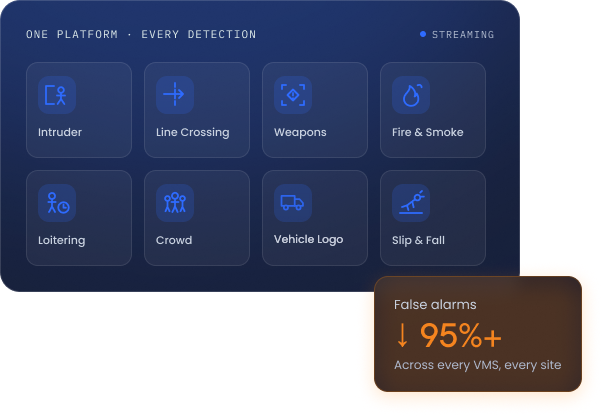
Intruder, line crossing, weapons, loitering, crowd, and vehicle logo detection. Actuate runs all of them on the cameras and VMS you already operate.
One AI layer, no new hardware, no separate vendor per threat type.

TRUSTED BY LEADING MONITORING CENTERS WORLDWIDE





DEFINITION
What Are AI Video Analytics Detections?
AI video analytics detections are the specific event types a computer vision system is trained to recognize in a camera feed, such as a person crossing a perimeter, a firearm coming into view, smoke forming, or a worker falling. Each detection is a separately trained model. Actuate runs its full detection set from one cloud platform, on the cameras and VMS a monitoring center already operates.
THE PROBLEM
One Platform, Not Nine Point Solutions
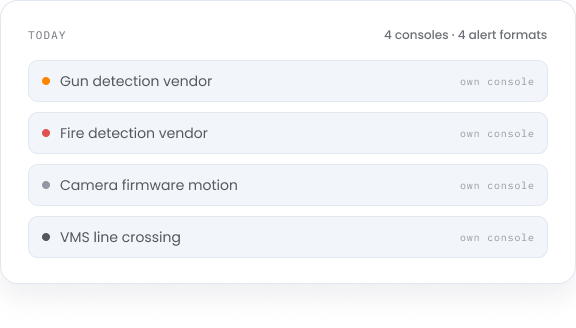
Most monitoring centers assemble detection coverage one vendor at a time. Gun detection from one supplier, fire from another, whatever the camera firmware happens to ship with for motion and line crossing. Each one has its own console, its own alert format, and its own definition of what counts as an event.
Operators absorb that on every shift: multiple interfaces to learn, inconsistent alerts to triage, and time lost deciding which system to trust.
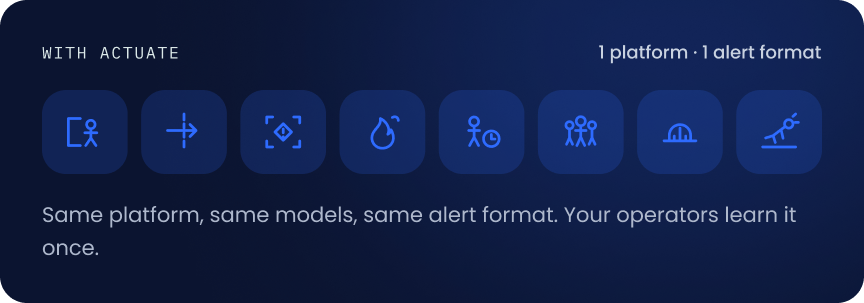
Actuate runs every detection through the same platform, the same models, and the same alert format. Your operators learn it once.
THE CATALOG
The Actuate Detection Catalog
Actuate AI security camera detections all run on your existing cameras through the same platform. Availability depends on your subscription tier.

01
Intruder Detection
Detects an unauthorized person entering a monitored area, and holds accuracy in low-resolution and low-light conditions where motion-triggered systems generate the most noise.
WHERE IT IS USED
Perimeters, yards, loading docks, vacant sites, after-hours interiors.

02
Line Crossing Detection
Creates virtual boundaries between safe zones and alert zones on a camera frame, and alerts only when a person or vehicle crosses in the direction you care about. Multiple lines can run in a single frame.
Directional logic is what keeps it quiet. Routine movement inside the frame does not trigger an alert, so operators get the same accuracy as full-frame intruder detection without the added alert volume.
COVERS
Perimeter fences, warehouse docks, campus boundaries, restricted zones inside an active site.

03
Weapons Detection
Identifies a firearm as it comes into view of an existing camera and routes the alert in real time, giving a security team an early warning rather than an after-action report.
Weapons detection runs alongside intruder, fire, and crowd detection on the same feeds. It is one capability in the platform, not a separate product.
WHERE IT IS USED
Schools, GSOCs and enterprise campuses, critical infrastructure, public-facing facilities.

04
Vehicle Logo Detection
Identifies delivery and service vehicles by the logo on the vehicle and flags them in real time, so an operator can tell an expected visitor from an unknown one at a glance. It recognizes the fleets that show up on a monitored site every day: UPS, FedEx, DHL, Amazon, USPS, fire trucks, and school buses.
Routine deliveries are one of the largest sources of nuisance alerts on a commercial site. Classifying the vehicle before the alert reaches an operator takes that traffic out of the queue instead of asking someone to dismiss it.
WHERE IT IS USED
Loading docks and gates, warehouses and distribution centers, construction sites, school campuses.

05
Loitering Detection
Identifies a person remaining in a monitored area longer than the dwell time you set, which is the pattern that precedes most theft and vandalism events.
Loitering is a temporal event. It only exists across time, which is why continuous video analysis handles it well and snapshot-based analysis struggles with it.
WHERE IT IS USED
Retail exteriors, parking structures, ATM and kiosk surrounds, building entrances.

06
Crowd Detection
Flags groups forming or gathering beyond a set threshold, so an operator sees a situation forming instead of reviewing it afterwards.
COVERS
Public spaces, campuses, transit areas, large facility entrances.
COVERAGE MAP
Which Detections Fit Which Sites
The most common video analytics use cases, mapped to the detection that covers them and the industries that ask for it most.
| Detection | Primary Use Case | Industry |
|---|---|---|
| Intruder | Primary use caseUnauthorized entry into a monitored area | IndustryConstruction, warehousing, critical infrastructure |
| Line Crossing | Primary use caseDirectional perimeter and boundary breach | IndustryConstruction, warehouses and logistics, campuses |
| Weapons | Primary use caseEarly warning on a firearm in view | IndustrySchools, GSOCs and enterprise, critical infrastructure |
| Fire and Smoke | Primary use caseEarly fire detection outside fire-panel coverage | IndustryConstruction, warehousing, critical infrastructure |
| Loitering | Primary use casePre-incident warning before theft or vandalism | IndustryRetail exteriors, parking, public spaces |
| Crowd | Primary use caseGroups forming beyond a set threshold | IndustryPublic spaces, schools, transit and large venues |
| Vehicle Logo | Primary use caseTelling expected fleet vehicles from unknown arrivals | IndustryWarehouses and logistics, construction, schools |
| Slip and Fall | Primary use caseImmediate response to a person down | IndustryWarehouses and logistics, industrial facilities |
ARCHITECTURE
Streaming-First Detection Is Why the List Works
Some events exist in a single frame. A firearm is either in view or it is not.
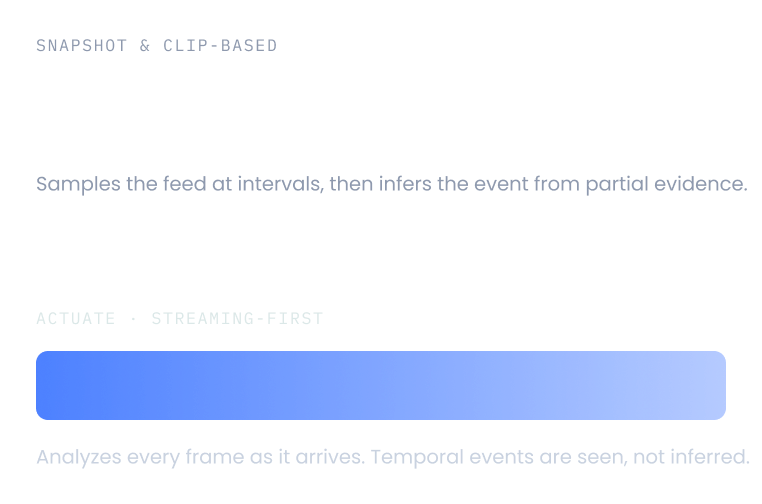
Most of the events that matter to a monitoring center do not work that way. A fall, a loitering pattern, a crowd forming, a vehicle approaching a line: these only exist across time. Snapshot and clip-based systems sample the feed at intervals, so they infer those events from partial evidence.
Actuate analyzes the stream continuously. Eight years of streaming-video-first training is why accuracy holds on the detections that depend on time, and why alerts reach an operator faster.
IN PRODUCTION
What That Looks Like in Production
FALSE ALARM REDUCTION
Reduction in false positives across deployed sites.
ALARMS / MONTH
Eliminated for a single monitoring center client.
OF TRAINING DATA
Eight years of streaming-video training data, the data moat behind our accuracy.
MONITORING CENTERS
Run on Actuate today.
ETHICS BY ARCHITECTURE
What Actuate Does Not Detect
FAQ
Frequently Asked Questions
What can AI video analytics detect?
Actuate detects intruders, weapons, fire and smoke, loitering, line crossing, crowd formation, delivery and service vehicles by logo, and slips and falls. Each detection is a separately trained model running on the same platform, across the cameras and VMS a site already operates.
Do I need a different system for each detection type?
No. Every Actuate detection runs through one platform and produces one standardized alert format. Operators learn a single interface regardless of how many detection types are active or how many camera brands are in the estate.
Do these detections require new cameras?
No. Actuate is software only and connects to existing IP, thermal, and PTZ cameras through the VMS you already run, including Genetec, Milestone, and Immix. There are no hardware changes and no truck rolls.
How does Actuate avoid false alarms on these detections?
Actuate analyzes the live video stream continuously rather than sampling periodic snapshots, and classifies events before they reach an operator screen. Deployed sites see a 95%+ reduction in false positives.
Which detections are included in my subscription?
Detection availability depends on your subscription tier. Upgrading a tier includes every analytic from the tiers below it at no additional cost. See the full tier comparison on the Pricing page.
Can existing cameras work as threat detection AI cameras?
Yes. Actuate turns an existing camera into a threat detection AI camera in software, with no replacement and no added hardware. The camera keeps recording as it always has, and Actuate applies the detection models to the live stream it is already producing.
Does Actuate use facial recognition to make these detections?
No. Actuate uses no facial recognition, no biometric databases, and no relational mapping. The platform detects objects and events, not identities.
Does Actuate read license plates?
Actuate does not read license plates. Vehicle Logo Detection identifies the livery on a delivery or service vehicle, such as a UPS or FedEx truck, which tells an operator that a known fleet has arrived. It does not read plate numbers and does not connect a vehicle to a registered owner or driver.
SEE IT LIVE
See the Detections Run on Your Hardest Site
Book 30 minutes and watch the platform detect on live cameras. Real system, real feeds, no smoke and mirrors.
No new hardware · Onboard in minutes · Works with your VMS
EXPLORE FURTHER
THE PLATFORM
DETECTION DETAIL
DETECTION DETAIL
TIERS & ADD-ONS